
The Tephra Seismites group ran a very successful hui, entitled ‘Our earth-shaking discoveries so far!’, for our supporters, mana whenua partners, and stakeholders, on Tuesday 25 July 2023.
After an introduction to the project, we began with a workshop, ‘Core blimey!’ where we laid out opened lake cores, and had a discussion about the significance of lake sediment cores and the tephra beds inside them.

On display were a long set of cores from Lake Pikopiko that showed numerous tephra layers, spanning eruptions that occurred 2800 to 17500 years ago, while cores from Rotoroa (Hamilton Lake) and Wairotoiti/Ngārotoiti gave examples of the tephra and alluvial sediment liquefaction features we have been studying.

Cores: top left, Wairotoiti/Ngārotoiti; bottom left, Rotoroa/Hamilton Lake; right, Pikopiko. Coloured labels give the tephra names; ‘Alluvium’ is river-derived sediment; the numbers on the right give the tephra/sediment age in thousands of years.
We had seven talks from the main research group members. Dr Max Kluger led with ‘Towards understanding seismic hazard in the Hamilton Basin’, an overview of the entire project and key findings to date.
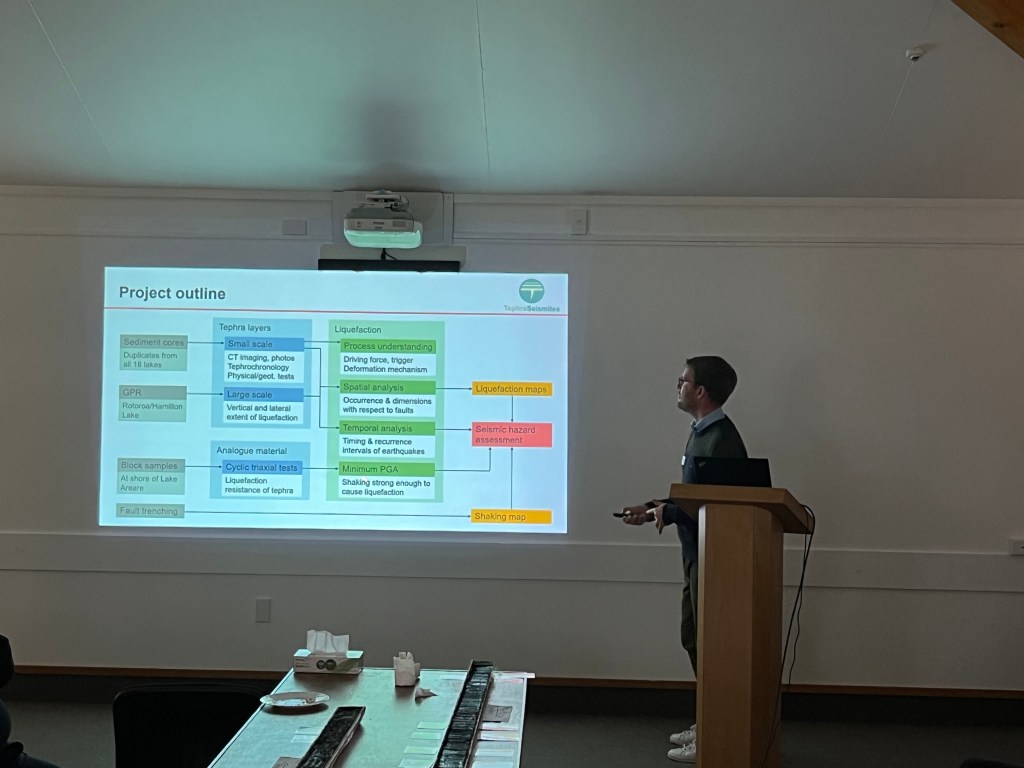
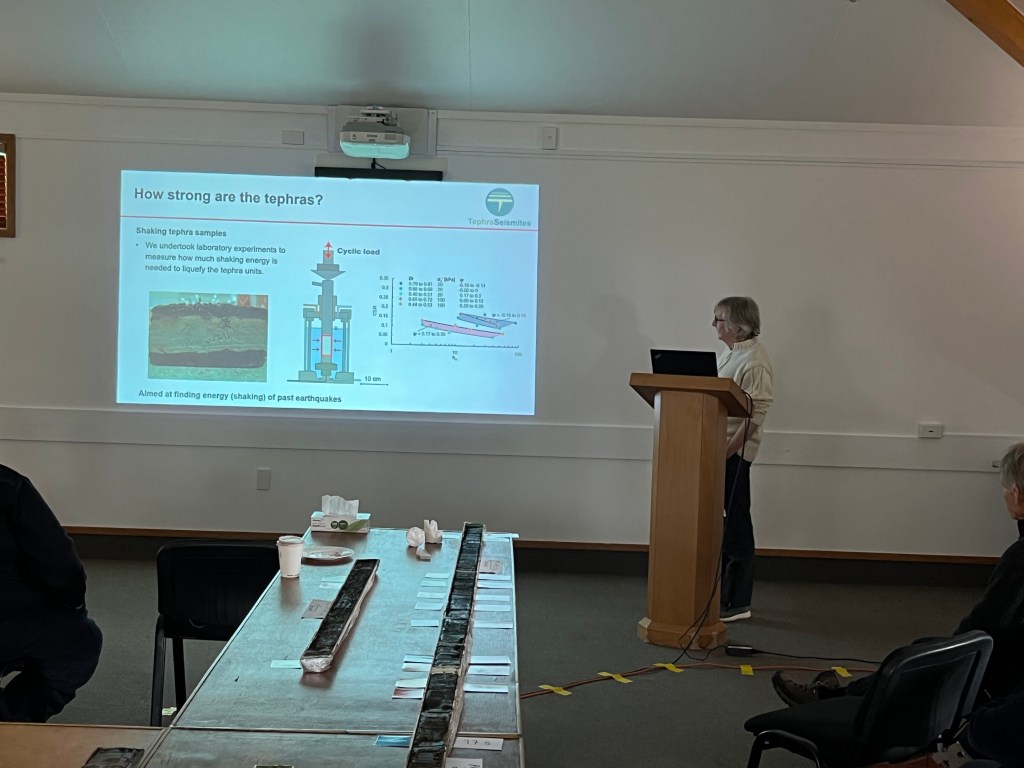
Five shorter talks that followed focused on different areas of the project: ‘Cores on a fine scale: using CT scans to understand lake sediments’ (Dr Tehnuka Ilanko); ‘Messing about in boats: investigating distribution of liquefaction features in lake sediments using ground-penetrating radar’ (Richard Melchert); ‘Our precious lakes’ (Prof. David Lowe); ‘Not our fault: Te Puninga Fault near Morrinsville’ (Josh Hughes); ‘Using laboratory liquefaction testing to estimate past earthquake shaking’ (Jordanka Chaneva). We wrapped up with a summary and an idea of next steps towards modelling past earthquake shaking from Dr Vicki Moon.
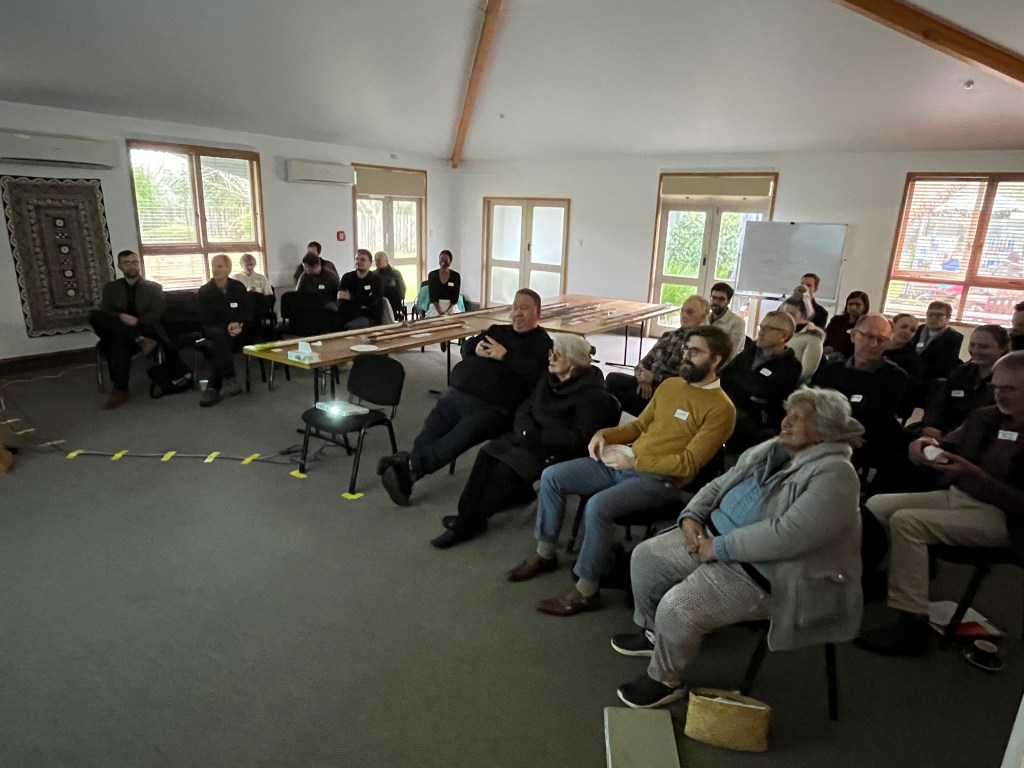
Many thanks to mana whenua representatives from Ngāti Wairere and Ngā Iwi Toopu O Waipa, and all who attended – we are grateful for your support and interest.
 Tephra Seismites